
A miter saw is only as good as the stand it sits on. Whether you’re trimming baseboards in a client’s living room or breaking down sheet goods in your garage, a solid saw stand transforms a capable tool into a precision workstation. DeWalt miter saw stands have earned their reputation in both professional job sites and home workshops for a reason: they’re engineered to handle real-world jobsite abuse while keeping cuts accurate and repeatable. But walk into any tool retailer and you’ll face a half-dozen models with overlapping specs and confusing feature lists. This guide cuts through the marketing noise to help you pick the right stand for your work, and get it set up correctly the first time.
Table of Contents
ToggleKey Takeaways
- A DeWalt miter saw stand provides stable, level support at the correct working height while reducing back strain and enabling longer workpiece handling without a helper.
- Portable rolling stands with pneumatic wheels offer mobility and 300-pound capacity for job sites, while stationary stands sacrifice portability for heavier loads and rock-solid stability in fixed locations.
- Prioritize weight capacity (300 pounds minimum for sliders), support arm length (8 feet total), wheel quality, and one-handed folding mechanisms when selecting a DeWalt miter saw stand.
- Proper setup requires leveling the stand, extending and locking support arms, mounting the saw with quick-release levers, and using adjustable stops for accurate repetitive cuts.
- Regular maintenance with dry PTFE lubricants, bolt tightness checks, and proper storage in dry conditions ensures your DeWalt stand remains accurate and safe for years of cutting projects.
Why You Need a DeWalt Miter Saw Stand
Setting a miter saw on a workbench or sawhorse might work for one or two cuts, but it’s a setup that costs you time, accuracy, and safety on any real project.
A dedicated miter saw stand provides a stable, level platform at the correct working height, typically 34 to 36 inches, which reduces back strain during long cutting sessions. More importantly, it extends support on both sides of the blade, letting you handle longer stock without a helper. Try cutting an 8-foot crown molding piece on a workbench and you’ll immediately understand why outfeed support matters.
DeWalt stands also incorporate material stops and mounting brackets that keep your saw locked in position. When you’re making repetitive crosscuts to the same length, say, cutting studs for a wall frame, adjustable stops eliminate the need to measure each piece. That’s not just convenience: it’s consistency that shows up in how tight your miters fit.
For contractors, portability seals the deal. A DeWalt rolling miter saw stand folds up, fits in a truck bed, and sets up in under a minute on the next site. Even weekend DIYers benefit: you can roll the whole setup into a corner or against a wall when the project wraps up, reclaiming valuable garage floor space.
Safety deserves mention here. A wobbly or undersized stand increases the risk of kickback and binding, especially on angled cuts where the workpiece can shift. DeWalt’s mounting systems and wide stance geometry minimize that risk.
Types of DeWalt Miter Saw Stands Explained
DeWalt offers two main categories of miter saw stands, each designed for different work environments and user priorities. Understanding the trade-offs helps you avoid buying the wrong tool for your workflow.
Portable Rolling Stands
Portable rolling stands dominate DeWalt’s lineup for good reason: they balance mobility, capacity, and price in a package that works for most users.
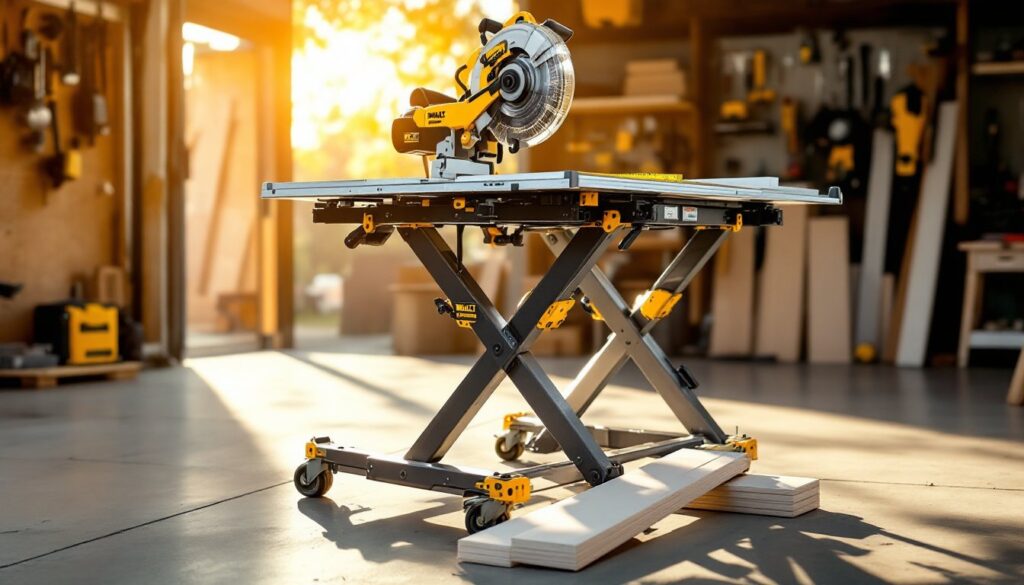
The DeWalt DWX726 rolling miter saw stand is the brand’s flagship portable model. It features pneumatic wheels (think lawnmower tires, not hard plastic casters) that handle gravel, job site debris, and rough terrain without jamming. The stand folds and unfolds via a single lever, and transport locks keep everything secure in transit.
Weight capacity on the DWX726 tops out at 300 pounds, more than enough for a 12-inch sliding compound miter saw plus material. Extendable support arms adjust out to handle workpieces up to 8 feet long, with flip-up stops that can be positioned anywhere along the rails.
The legs use a tubular steel design that resists racking (side-to-side wobble), and rubber feet provide grip on smooth shop floors. Many woodworking project plans recommend rolling stands for trim carpentry and framing work where you’re moving between rooms or floors.
Other portable models like the DWX723 and DWX724 offer lighter-duty alternatives with smaller wheels and lower weight capacities (around 200 pounds). These work fine for 10-inch saws or users who prioritize minimal weight over maximum stability.
Heavy-Duty Stationary Stands
Stationary stands trade portability for rock-solid stability and higher weight limits. These are bolt-together or weld-frame designs meant to stay in one spot, your workshop, a dedicated cutting station, or a job trailer.
DeWalt’s stationary options (often found under the DW7350 designation) use thicker gauge steel and a wider leg spread, sometimes exceeding 60 inches. Weight capacities can reach 500 pounds, accommodating the heaviest 12-inch dual-bevel sliders plus auxiliary fences and dust collection rigs.
The mounting surface on stationary stands is typically larger and may include T-slots or threaded inserts for attaching custom fences, tool trays, or hold-downs. If you’re setting up a permanent trim station or running production cuts (like a cabinet shop cutting face frames), the added rigidity pays off in cut quality and tool longevity.
Downside: these stands are heavy (60+ pounds assembled) and bulky. Moving one usually means disassembly. If your workspace doubles as a parking spot or you work on multiple sites per week, a stationary stand becomes a liability.
Top Features to Look for in a DeWalt Miter Saw Stand
Not all miter saw stands are created equal, even within the same brand. Here’s what separates a frustrating purchase from a tool that earns its place in your truck.
Weight Capacity and Material Support Length
Check the stand’s rated capacity against your saw’s weight plus the weight of typical workpieces. A 12-inch sliding saw can weigh 50 to 70 pounds: add a 16-foot piece of PVC trim or a stack of 2x4s, and you’re pushing 100+ pounds on the rails. Portable stands rated for 250 pounds may sag or flex under that load. Aim for 300 pounds minimum if you’re running a slider.
Support arms should extend to at least 8 feet total (4 feet on each side of the blade). Longer is better for siding, crown, and baseboard work. Adjustable stops along those rails let you set up repetitive cuts without tape measures.
Mounting System Compatibility
DeWalt uses a universal mounting bracket system on most stands, but verify that your specific saw model is listed as compatible. Some older saws or non-DeWalt brands may require aftermarket adapters. The mounting brackets should lock with a quick-release lever, no bolts or wrenches required.
Wheel Quality (for Rolling Stands)
Hard plastic wheels are fine for smooth concrete. Pneumatic or semi-pneumatic tires (like those on the dewalt dwx726 rolling miter saw stand) handle cracked driveways, dirt, and job sites with debris. If you work outdoors or on unfinished lots, spend the extra $30 for real tires. You’ll thank yourself the first time you don’t have to carry a 90-pound setup over gravel.
Setup and Breakdown Speed
Look for stands with one-handed or single-lever folding mechanisms. Multi-step setups (release four pins, fold two legs, collapse the rails, lock three latches) waste time and increase the chance of pinched fingers. On a busy site, setup time matters. Many professional crews using workshop tool reviews rate ease of deployment as highly as weight capacity.
Height Adjustment
Some stands offer telescoping legs or adjustable feet to accommodate uneven ground or different user heights. If you’re 6’2″ and your cutting partner is 5’6″, adjustable height prevents one of you from hunching or overreaching. A 2-inch adjustment range is typical and usually sufficient.
Dust Port Integration
Not all stands include dust collection ports, but many DeWalt models have mounting points for aftermarket dust shrouds or shop vac adapters. If you’re working indoors, this isn’t optional, miter saws generate a shocking amount of fine dust that coats everything and poses a respiratory hazard. Wear a respirator rated for fine particulates (N95 minimum) even with a dust collection system running.
Build Quality and Warranty
Inspect welds, pivot points, and locking levers before you buy. Thin-wall tubing and plastic locks won’t survive a season of job site use. DeWalt typically offers a three-year limited warranty on their stands, which is above average for this category. Check the fine print: some warranties exclude wheels and plastic components.
How to Set Up and Use Your DeWalt Miter Saw Stand
Even the best stand won’t perform if you skip setup steps or ignore basic maintenance. Here’s how to get yours running right.
Initial Assembly
- Unfold the stand on level ground. Engage all leg locks and verify the frame is fully extended before mounting your saw. Partial deployment is a common cause of collapse.
- Mount the saw using the included brackets. Align the saw’s mounting holes with the stand’s bracket slots, drop the saw into place, and tighten the locking levers. Give the saw a firm tug forward and back to confirm it’s seated.
- Extend and lock the support arms on both sides of the blade. Position the adjustable stops at your desired cutting length. If you’re cutting multiple pieces to the same dimension, clamp a stop block to the rail for consistent results.
- Check for level. Place a 24-inch spirit level across the saw’s table, parallel to the fence. Adjust the stand’s feet or shim under one leg if needed. An unlevel setup causes angled cuts even when the saw is set to 0 degrees.
Safety Setup
Always wear safety glasses and hearing protection when operating a miter saw. Fine dust from treated lumber or composite materials requires a respirator, don’t rely on the stand’s dust port alone.
Secure the workpiece against the fence before cutting. Even with support arms extended, material can shift during the cut, especially on miter and bevel angles. Use a clamp or hold-down if you’re cutting small pieces (under 12 inches).
Using Stops for Repetitive Cuts
For projects like cutting studs, deck boards, or trim pieces, set your stop once and cut all identical pieces before moving on. Mark your cut line on the first piece, position the stop, and verify the measurement with a tape measure. This method is faster and more accurate than marking each piece individually. Professionals relying on seasonal repair guides often credit stop-block setups for cutting project time in half.
Transport and Storage
When moving a rolling stand, remove the saw or lock it down with a bungee cord. A saw bouncing loose in a truck bed can damage the stand’s mounting brackets or the saw’s alignment.
Before folding the stand, retract the support arms fully and release the leg locks in the correct sequence (consult your manual, some stands have a specific order to prevent binding). Store the stand in a dry location: road salt and moisture will corrode the steel frame and seize the folding mechanism.
Maintenance
Lubricate pivot points and slide rails with a dry PTFE spray (like Teflon) every few months. Avoid oil-based lubricants, they attract sawdust and gum up the mechanism. Check wheel mounting bolts and leg lock pins for tightness before each use. Loose hardware is the leading cause of stand failure in the field.
If the stand develops play or wobble, inspect the welds and tubular joints for cracks. A cracked frame is not repairable and should be replaced immediately, don’t risk a saw falling mid-cut.
Conclusion
A DeWalt miter saw stand isn’t a luxury accessory, it’s the foundation of accurate, safe, and efficient cutting. Whether you’re running a framing crew or tackling weekend trim projects, the right stand turns a good saw into a complete workstation. Match the stand type to your workflow: portable for job sites and tight spaces, stationary for production work and permanent setups. Prioritize weight capacity, wheel quality, and ease of deployment over gimmicks. And don’t skip the setup steps, a level, well-maintained stand delivers clean cuts for years.