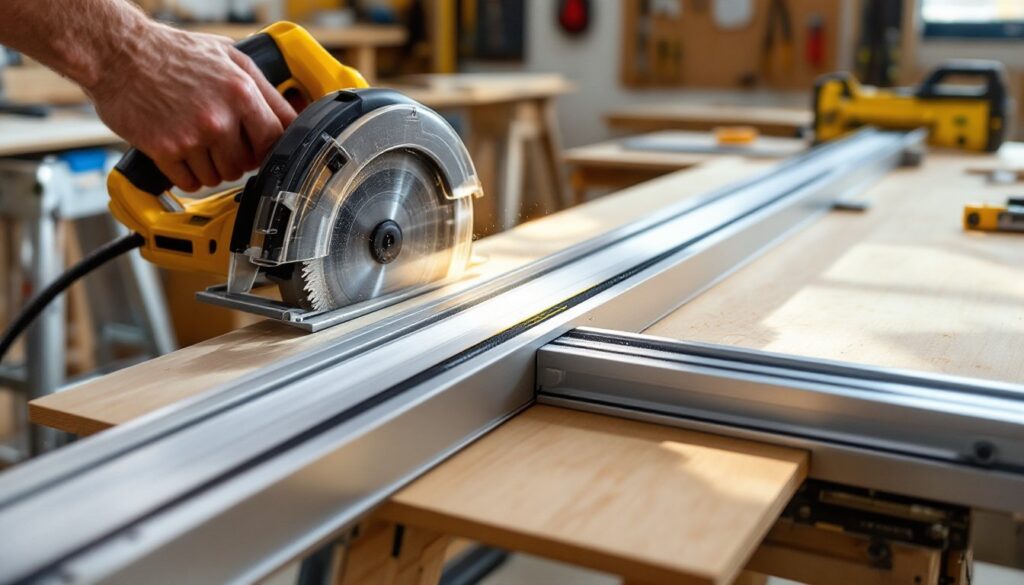

Ripping a full sheet of plywood or making precise crosscuts with just a circular saw and a pencil line? That’s a recipe for wavy edges and wasted material. A circular saw guide rail changes the game entirely, transforming your standard circular saw into a precision cutting tool that rivals track saws costing three times as much. Whether you’re breaking down sheet goods for cabinets, trimming door jambs, or cutting long bevels in hardwood, a guide rail system delivers repeatable, splinter-free cuts without the guesswork. For DIYers working in garages or job sites without a full table saw setup, it’s one of the most versatile upgrades you can make.
Table of Contents
ToggleKey Takeaways
- A circular saw guide rail transforms your standard circular saw into a precision cutting tool by providing a straight reference edge that aligns exactly with your cut line, eliminating offset calculations and delivering table saw-level accuracy without the cost or space.
- The anti-splinter strip and stable guidance of a guide rail system produce cleaner cuts with virtually zero tearout on veneered plywood and melamine, significantly reducing waste and finishing work on expensive sheet goods.
- Universal circular saw tracks are affordable ($50–$150), compatible with most existing saws via an adapter plate, and ideal for DIYers who already own a quality circular saw but need professional-grade cutting precision.
- Choosing the right guide rail depends on your specific needs: rail length (55 inches for crosscuts, 100+ inches for full sheets), compatibility with your saw model, anti-splinter strip quality, and dust collection capabilities.
- Proper setup and technique—including securing the rail firmly, adjusting blade depth to 1/4 inch beyond the workpiece, using a 40-tooth blade for plywood, and maintaining steady feed pressure—ensure repeatable, splinter-free cuts on every project.
- A guide rail system for under $200 combines portability, safety, and versatility for ripping, crosscutting, bevels, and even router work, making it one of the most cost-effective upgrades a DIYer can make.
What Is a Circular Saw Guide Rail and How Does It Work?
A circular saw guide rail (sometimes called a track for circular saw or circular saw track) is an aluminum or composite extrusion that clamps or sits atop your workpiece, providing a straight reference edge for your saw’s base plate to ride along. Most rails feature a rubberized strip on the underside to prevent slipping and a groove or ridge on top that mates with an adapter plate attached to your saw.
The saw slides smoothly along the rail, keeping the blade perfectly aligned from start to finish. Many systems include an anti-splinter strip, a sacrificial edge that the blade cuts through on the first pass, creating a zero-clearance fence that virtually eliminates tearout on veneered plywood or melamine.
Unlike a clamped straightedge, which requires you to offset your measurement to account for the distance between the blade and the edge of the saw’s base, a circular saw track guide is designed so the edge of the rail aligns exactly with the cut line. Mark your cut, position the rail, and go, no math, no offset jigs.
Typical rail lengths range from 40 inches to 118 inches, with many systems offering connectors to join multiple sections for cutting full 8-foot sheets or longer. The rail’s profile keeps the saw base elevated slightly, which also prevents binding when cutting through supported sheet goods.
Why Every DIYer Needs a Guide Rail System
Accuracy without a table saw. Not every DIYer has room (or budget) for a cabinet saw. A circular saw with a guide rail delivers table saw–level precision for rip cuts and crosscuts on sheet goods, all in a package that stores flat against a wall.
Cleaner cuts, less waste. The anti-splinter strip and stable guidance mean fewer blown-out edges, which translates to less sanding, filling, or edge-banding work, and fewer ruined boards. When you’re working with hardwood plywood at $80+ per sheet, that matters.
Portable and job-site friendly. A guide rail for circular saw weighs a few pounds and fits in a truck bed or on a shelf. Compare that to wrestling a 4×8 sheet of MDF across a stationary table saw in a cramped garage. You bring the tool to the material, not the other way around.
Versatility beyond ripping. Use the rail for bevel cuts (most systems tilt with the saw), dados with a straight bit in a router, or even scribing countertops. Some woodworkers keep dedicated project plans on hand that are designed specifically around track-guided cuts.
Safety. A stable, predictable cut path reduces kickback risk and keeps your hands farther from the blade. You’re not wrestling a spinning saw across an unsupported panel, everything’s locked down.
For under $200, a good rail system turns a $100 circular saw into a tool that handles tasks you’d otherwise need a $600 track saw or $1,500 cabinet saw to accomplish.
Types of Circular Saw Guide Rails
Dedicated track saw systems come as a matched pair: saw and rail designed together. Brands like Festool, Makita, and DeWalt offer these. The saw locks onto the rail with minimal play, often includes dust collection ports that mate with shop vacs, and delivers near-perfect cuts right out of the box. Expect to pay $400–$700 for the combo.
Universal circular saw tracks are aftermarket rails that work with most sidewinder and worm-drive circular saws via an adapter plate you attach to the saw’s base. Popular options include Kreg’s Accu-Cut and various aluminum extrusion systems. These run $50–$150 and are ideal if you already own a quality circular saw. They won’t have quite the refinement of a dedicated track saw, but for most DIY work, the difference is negligible.
DIY guide rails can be shop-made from straight hardwood, MDF, or even factory edges of plywood, paired with clamps. They work in a pinch and cost almost nothing, but they lack the anti-splinter strip, require offset calculations, and can shift if not clamped carefully. Fine for rough work: not ideal for finish carpentry.
Universal vs. Brand-Specific Rails
Brand-specific rails (Festool, Makita, Bosch) offer the tightest tolerances, proprietary dust collection, and accessory ecosystems, clamps, angle guides, cross-cut stops. If you’re building a professional or serious hobbyist toolkit around one brand, the integration is unbeatable.
Universal rails sacrifice a bit of fit and finish but open the door to using any circular saw you already own. They’re excellent for weekend warriors who don’t want to invest in a whole new saw. Adapter plates typically mount with screws to the saw’s base: once installed, swapping between freehand and guided cuts takes seconds.
For most DIYers tackling kitchen remodels, built-ins, or home repair projects, a universal system hits the sweet spot of performance and value.
How to Choose the Right Guide Rail for Your Projects
Rail length. Common lengths are 55 inches (good for crosscutting plywood and cutting down 2×4 framing) and 100+ inches for full-sheet rips. If you regularly break down 4×8 sheets, look for a system with joinable rails or buy a single 8-foot track. Shorter rails are easier to store and transport but limit your capacity.
Compatibility with your saw. Check the manufacturer’s compatibility list or adapter plate options. Most universal systems fit saws with base widths between 6 and 7.5 inches, but double-check before buying. If you run a worm-drive saw, confirm the adapter accommodates the motor’s position.
Anti-splinter strip. This feature is non-negotiable if you’re cutting melamine, hardwood ply, or veneered panels. The strip is replaceable, so factor in the cost and availability of spares.
Material and build quality. Aluminum extrusions stay straight and resist warping better than composite or plastic rails. Check for a rubberized or cork underside to prevent slippage, essential when cutting vertically (trimming doors in place, for example).
Accessories and expandability. Rip guides, cross-cut squares, clamp blocks, and hinge connectors extend functionality. If you plan to use the rail with a router or jigsaw, verify compatibility with those tools too.
Dust collection. Some saws and rails integrate dust ports. Cutting sheet goods indoors without dust collection creates a mess and a health hazard. A good shop vac attachment makes cleanup faster and keeps your cut line visible.
Budget. For occasional use, building a few bookcases, trimming underlayment during a flooring project, a $60 universal rail is plenty. If you’re doing finish carpentry or flipping houses, invest in a dedicated track saw system. The time saved and reduction in material waste will pay for itself.
Setting Up and Using Your Guide Rail Like a Pro
1. Prep your workspace. Support the workpiece on sawhorses or a cutting table with clearance underneath for the blade. Use rigid foam insulation or sacrificial 2×4s as a cutting surface to prevent binding and protect your table.
2. Mark your cut line. Measure twice, mark once. Use a sharp pencil or marking knife for precision. If your rail has alignment marks or a clear viewing strip, position the rail’s edge directly on the line, no offset needed.
3. Secure the rail. Most rails include clamps or rely on their rubber strip for grip. For long cuts or vertical work, use spring clamps or the manufacturer’s accessory clamps to lock the rail in place. Check that the rail is fully seated and hasn’t shifted before powering up.
4. Set blade depth. Adjust the saw so the blade extends about 1/4 inch beyond the bottom of the workpiece. This minimizes tearout and reduces the risk of kickback. For beveled cuts, set your angle first, then adjust depth.
5. Wear PPE. Safety glasses and hearing protection are mandatory. A dust mask or respirator is a good idea if you’re not using a shop vac for dust collection.
6. Make the cut. Place the saw on the rail at the starting end, engage the blade before it contacts the material, and push smoothly. Let the saw do the work, don’t force it. Keep the saw’s base plate firmly against the rail throughout the cut. Many step-by-step guides recommend a steady, moderate feed rate to avoid burning or chipping.
7. Check your edge. After the first cut, inspect the anti-splinter strip. It should have a clean kerf. Subsequent cuts will be even cleaner. If you see blowout, verify blade sharpness and feed rate.
Pro tips:
- Climb-cut prevention: Always push the saw forward, never pull it backward along the rail.
- Blade choice: Use a 40-tooth or finer blade for plywood and a 24-tooth blade for framing lumber.
- Zero-clearance setup: Run the saw along the rail with the blade retracted, then lower it through the anti-splinter strip for the first pass. This creates a custom zero-clearance edge for that exact blade.
- Vertical cuts: When trimming door bottoms or cutting installed panels, clamp the rail securely and check that the saw won’t snag on anything mid-cut.
Conclusion
A circular saw with guide rail isn’t just an accessory, it’s a fundamental upgrade that unlocks precision, repeatability, and confidence in your cuts. Whether you’re breaking down sheet goods in a driveway or trimming trim in place, the rail keeps your cuts straight, your edges clean, and your workflow efficient. Invest in a system that matches your saw and project scale, practice setup and feed technique, and you’ll wonder how you ever managed without it.