
Carpenter ants aren’t termites, but they’ll still tear through your framing lumber like it’s wet cardboard. Unlike their wood-eating cousins, these ants excavate rather than consume wood, but the damage is just as real. Homeowners often discover an infestation only after noticing sawdust piles or hearing faint rustling inside walls. The good news? With the right identification, treatment, and prevention approach, most carpenter ant problems can be handled without hiring an exterminator. This guide walks through proven control methods, from spotting the first scouts to sealing entry points and eliminating colonies for good.
Key Takeaways
- Carpenter ants excavate wood rather than consume it; identifying sawdust piles, frass, and smooth-bodied workers 1/4 to 1/2 inch long helps distinguish them from termites and common household ants.
- Carpenter ant control requires a combination approach: use bait stations with boric acid or fipronil along trails, apply diatomaceous earth in wall voids, and locate nests by following foraging trails at night or listening for rustling sounds behind walls.
- Eliminate outdoor nesting sites in rotted stumps, stacked firewood, and moist wood immediately, as satellite colonies inside your home will persist until parent colonies are destroyed.
- Moisture is the primary factor attracting carpenter ants; fix roof leaks, extend gutters away from foundations, remove wood-soil contact, and ventilate crawlspaces to prevent re-infestation.
- Call a professional exterminator if DIY treatments fail after 30 days, multiple swarms emerge indoors, structural damage is visible, or nests are inaccessible—expect to pay $250–$1,200 depending on treatment scope.
How to Identify Carpenter Ants in Your Home
Carpenter ants are larger than common household ants, workers range from 1/4 to 1/2 inch in length. They’re typically black, though some species show red or brown coloration. The easiest tell is their body shape: a smooth, rounded thorax (the segment between head and abdomen) with a single, prominent node between thorax and abdomen. Regular black ants have an uneven or humped thorax.
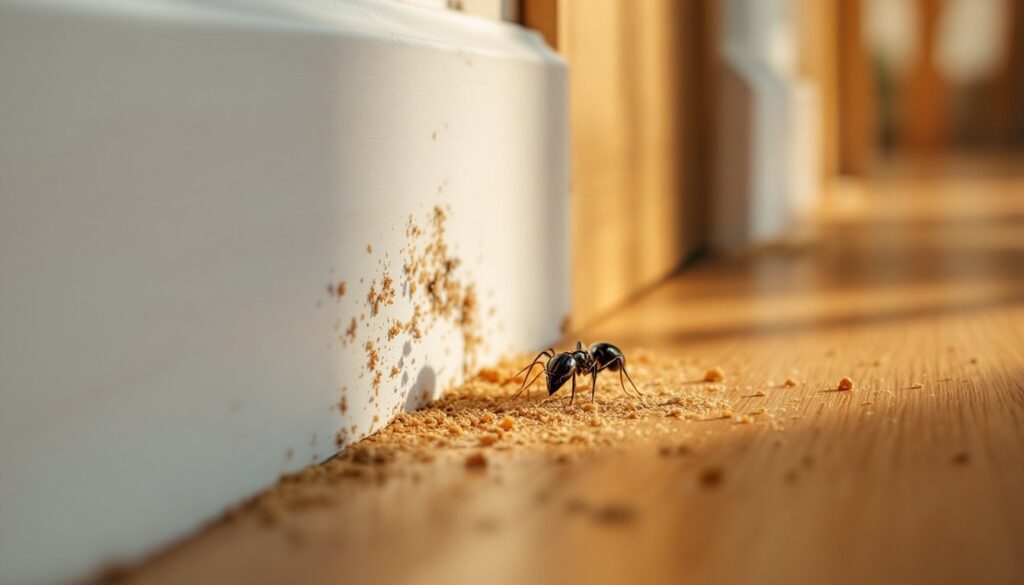
Look for frass, the fine sawdust-like material carpenter ants kick out of their galleries. It accumulates below exit holes and often contains insect body parts. You won’t see frass from termites, they use their waste to build mud tubes.
Swarmers (winged reproductives) emerge in spring. Carpenter ant swarmers have front wings noticeably longer than hind wings, and their waist is pinched. Termite swarmers have equal-length wings and a thick waist. Seeing swarmers indoors almost always means a colony is nesting inside your structure, not just foraging from outside.
Active carpenter ants follow trails along baseboards, window sills, and plumbing penetrations, usually at dusk or after dark. Set a flashlight near suspected areas after 10 p.m. and check for trails. If you see twenty or more ants in a single trail, you likely have a mature colony nearby.
Understanding Why Carpenter Ants Invade Your Property
Carpenter ants need three things: moisture, wood, and a food source. They prefer softened or rotted wood, not because they eat it, but because it’s easier to excavate. Check anywhere water intrusion has compromised framing: leaky roofs, failed flashing, condensation-prone rim joists, or poorly vented crawlspaces.
Common nesting sites include:
- Window and door headers where caulk has failed and moisture seeps in
- Hollow porch columns and railings with end-grain exposure
- Wood siding in contact with soil or mulch
- Attic rafters near roof leaks or ice dam damage
- Foam board insulation sandwiched between studs (they’ll tunnel through it to reach wood)
Foraging ants enter through tiny cracks, gaps around electrical conduit, plumbing pipes, or foundation sills. Once inside, they follow scent trails to sugary or protein-rich food. Pet food left out overnight and grease buildup near appliances are major attractants.
Satellite colonies often form in dry areas (interior walls, insulation batts) while the parent colony remains in moist wood outdoors, such as a rotting stump or stacked firewood. Eliminating outdoor nesting sites is just as critical as treating indoor infestations. Carpenter ant activity from outdoor colonies can lead to problems requiring professional pest control services, especially when structural damage is extensive.
DIY Carpenter Ant Control Methods That Actually Work
Natural and Chemical Treatment Options
For active infestations, a combination approach works best. Bait stations containing boric acid or fipronil let foraging ants carry poison back to the colony. Place baits along trails and near suspected entry points, not directly on the trail, which can disrupt foraging behavior. It takes 7–14 days for bait to cycle through the colony.
Diatomaceous earth (DE) is a mechanical killer: the powder’s microscopic edges cut through ants’ exoskeletons, causing dehydration. Apply food-grade DE into wall voids through outlet covers (power off the circuit first) and around exterior foundation perimeters. Wear an N95 mask, DE is non-toxic but irritating to lungs.
For immediate knockdown, non-repellent insecticides like soapy water can disrupt ant trails and kill individual workers. Mix one tablespoon of dish soap per quart of water in a spray bottle. This won’t eliminate the colony but reduces visible activity while baits do their work.
Residual sprays containing bifenthrin or permethrin create a barrier around door thresholds, window sills, and foundation gaps. Spray a band 3–6 inches wide and 2–3 feet up the foundation. Reapply every 60–90 days or after heavy rain. Always read product labels, some formulations aren’t safe for use near pets or edible gardens.
Avoid repellent sprays (pyrethrins, anything labeled “instant kill”). They scatter ants and fracture colonies into multiple satellite nests, making the problem worse.
Locating and Eliminating Carpenter Ant Nests
The only way to permanently solve a carpenter ant infestation is to destroy the nest. Start by tracking foragers back to their entry point. At night, follow trails to cracks, gaps, or wall penetrations. Tap along baseboards and studs with a screwdriver handle, a hollow sound or soft, punky feel indicates damaged wood.
If the nest is accessible (inside a hollow column, beneath a deck board, or in an exterior stump), use a drill and bulb duster to inject insecticidal dust directly into the gallery. Drill a 1/8-inch hole every 6 inches along the suspected gallery path. Inject boric acid dust, then plug holes with wood filler.
For nests inside walls, locate the general area by sound, carpenter ants are loud chewers. Late at night, press your ear against the wall near suspected sites. You’ll hear a faint rustling or crinkling, like crumpling cellophane. Once located, drill a small access hole and apply dust treatment.
Outdoor colonies in stumps, logs, or firewood piles should be removed entirely. If the wood can’t be moved, saturate it with a liquid termiticide or dig it out and replace with gravel. Never store firewood against the house, keep it at least 20 feet from the foundation and elevated off the ground on a rack.
Preventing Future Carpenter Ant Infestations
Prevention is about removing the conditions carpenter ants need. Start with moisture control, the single biggest factor in re-infestation.
Exterior prevention steps:
- Trim tree branches within 6 feet of the roof. Ants use them as bridges.
- Replace rotted fascia boards, soffits, and siding. Paint or seal all end grain.
- Grade soil away from the foundation (minimum 6-inch drop over 10 feet).
- Clean gutters and downspouts. Extend downspouts at least 4 feet from the foundation.
- Remove wood-soil contact: pull mulch back 12 inches from siding, and replace wood landscape timbers with stone or composite.
- Seal foundation cracks and gaps around utility penetrations with polyurethane caulk or expanding foam.
Interior prevention steps:
- Fix leaks immediately, roof, plumbing, or HVAC condensation. Check under sinks and around toilets.
- Ventilate crawlspaces and attics. Install vapor barriers in crawlspaces per IRC standards (minimum 6-mil polyethylene).
- Store firewood, lumber, and cardboard off the ground and away from living spaces.
- Vacuum up crumbs and wipe down counters nightly. Carpenter ants forage indoors for food even if they nest outside.
Annual inspections catch problems early. Regular home maintenance practices help identify moisture issues before carpenter ants move in. Check attics in early spring before swarmers emerge, and inspect crawlspaces after heavy rain. Catching a few scouts is far easier than dealing with an established colony.
When to Call a Professional Exterminator
Some infestations exceed DIY capacity. Call a licensed pest control operator if:
- You’ve treated for 30 days with baits and dusts but still see active trails.
- Multiple swarms have emerged indoors over consecutive years.
- Structural damage is visible, sagging floors, soft headers, or crumbling wood.
- The nest is inside an inaccessible area: between floors, inside a load-bearing wall, or under a concrete slab.
- You’re dealing with a large outdoor colony in a tree threatening the home’s structure.
Professionals have access to non-repellent liquid treatments (such as Termidor or Taurus SC) not available to consumers, and they carry the equipment to inject product into wall voids without demolition. They’ll also identify contributing structural issues, failed vapor barriers, inadequate ventilation, or hidden leaks.
Expect to pay $250–$500 for an initial interior treatment in most markets, with follow-up visits often included. Whole-property treatments (interior, exterior perimeter, and yard) can run $500–$1,200 depending on home size and infestation severity. Pricing varies by region and level of damage.
If you’re seeing carpenter ants alongside other signs of wood damage, like soft spots in flooring or visible rot, hire a general contractor or structural engineer to assess before treating. Carpenter ant damage can compromise load-bearing members, especially in older homes where framing lumber is undersized by modern standards. Treat the infestation, but don’t ignore the underlying structural problem.