
When your dishwasher stops draining, leaves dishes dirty, or won’t start at all, the problem usually isn’t the entire machine, it’s a single component that’s failed. Understanding how dishwasher parts work and interact can save hundreds of dollars in service calls and help you decide whether to repair or replace. Most homeowners can diagnose common issues and swap out failing parts with basic tools and a little confidence. This guide breaks down the essential components, explains what they do, and shows you how to identify which part is causing trouble.
Key Takeaways
- Most dishwasher problems stem from individual dishwasher parts failing rather than the entire machine, saving you hundreds in service calls by learning to diagnose and replace components yourself.
- Dishwasher parts work across five core systems: water delivery (inlet valve, spray arms), drainage (drain pump, hose, check valve), electrical controls (control board, switches), heating (element, thermostat), and mechanical components (racks, gaskets).
- Common failing dishwasher parts include door gaskets ($15–$40), spray arms ($10–$30), drain pumps, inlet valves ($20–$60), and filter assemblies, which you can often replace with basic tools and minimal experience.
- To diagnose which part is failing, match your symptom (won’t start, won’t drain, poor cleaning, leaking) to the likely culprit and use a multimeter to test electrical components like the heating element and door switch.
- Always locate your dishwasher’s model number before ordering parts, choose OEM parts for complex components like control boards and pumps, and use reputable retailers with warranties to verify exact part numbers for guaranteed compatibility.
Understanding the Core Components of Your Dishwasher
Modern dishwashers contain dozens of parts, but the core systems break down into a few categories: water delivery, drainage, electrical controls, and heating. Each system relies on multiple components working in sync.
The tub is the stainless steel or plastic interior chamber that holds dishes. It’s not typically a wear item, but cracks or rust can develop over time, especially in older models with plastic tubs. The door latch and gasket create a watertight seal, a worn gasket or broken latch will cause leaks or prevent the machine from starting.
The control panel or touchpad is the user interface, but behind it sits the control board (also called the timer or electronic control). This circuit board manages cycle timing, water temperature, and all the sequencing that makes a wash cycle run. When buttons stop responding or cycles won’t advance, the control board is often the culprit.
The rack system, upper and lower racks plus the silverware basket, rides on rollers or wheels. Broken wheels or rusted racks are cosmetic annoyances until they prevent the door from closing or damage dishes. Replacement racks are model-specific but widely available.
The Spray Arm System: How Water Reaches Every Dish
The spray arms are the rotating nozzles, usually two or three per machine, that distribute pressurized water throughout the tub. Water enters the spray arms through a central hub, exits through jets, and the reaction force causes them to spin.
Over time, spray arm jets clog with mineral deposits or food particles. A clogged spray arm results in poor cleaning, especially on the top rack. Most spray arms snap or twist off without tools for cleaning, and many are dishwasher-safe themselves.
The spray arm mount or tower is the stationary pipe that delivers water to the upper spray arm. Cracks in this assembly cause weak spray pressure and leaks inside the tub. When diagnosing poor cleaning performance, always inspect spray arms for clogs and cracks before ordering parts.
Essential Parts That Control Water Flow and Drainage
Your dishwasher fills with fresh water and drains dirty water using a series of valves, pumps, and hoses. When water won’t enter or leave the machine, one of these parts has failed.
The water inlet valve controls the flow of water from your home’s supply line into the dishwasher. It’s typically located behind the lower kickplate, connected to a supply hose. This solenoid-operated valve opens when the control board signals a fill cycle. If your dishwasher won’t fill, or fills too slowly, the inlet valve screen may be clogged with sediment or the valve itself has failed. Expect to pay $20–$60 for a replacement inlet valve, depending on the model.
The drain pump forces dirty water out through the drain hose. Most modern dishwashers use a dedicated drain pump (older models may rely on the wash motor to handle drainage). If water pools in the bottom of the tub after a cycle, the drain pump may be clogged, jammed by broken glass or debris, or electrically burned out. You can access the pump by removing the lower spray arm and filter assembly.
The drain hose runs from the pump to your sink drain or garbage disposal. Kinks, clogs, or disconnections in this hose will prevent drainage. A less obvious issue: if the hose isn’t looped up high under the countertop (creating an air gap), dirty sink water can siphon back into the dishwasher.
The check valve (or flapper valve) prevents drained water from flowing back into the tub. If you notice standing water between cycles or a musty smell, the check valve may be stuck open. It’s usually a small rubber or plastic flap inside the pump housing.
Electrical and Heating Components You Should Know
The heating and electrical systems in a dishwasher are straightforward but critical for proper cleaning and drying.
The heating element is a metal loop or coil mounted in the bottom of the tub. It heats water during the wash cycle and provides radiant heat for drying. If dishes aren’t drying or water isn’t hot enough, test the element with a multimeter, it should read 15–30 ohms of resistance. A broken element shows infinite resistance and must be replaced. Heating elements cost $30–$80 and are relatively easy to swap if you’re comfortable disconnecting wire terminals.
The thermostat or temperature sensor monitors water temperature and signals the control board when the target temp is reached. A faulty thermostat can cause the machine to overheat, underheat, or never advance past the heating phase. Some models use a high-limit thermostat as a safety cutoff to prevent overheating.
The door switch is a small mechanical or magnetic switch that detects whether the door is closed. The dishwasher won’t start if the door switch is defective. It’s a cheap part ($10–$25) but can be tricky to access depending on the door panel design.
The float switch is a small plastic dome in the bottom of the tub that rises with water level. It prevents overfilling by signaling the control board to close the inlet valve. If your dishwasher overfills or won’t fill at all, the float may be stuck or the switch beneath it may be faulty.
Safety note: Always disconnect power at the breaker before working on any electrical components. Dishwashers run on 120V circuits, and water + electricity = serious hazard. Wear rubber-soled shoes and use insulated tools.
Common Dishwasher Parts That Require Replacement
Some dishwasher parts fail more frequently than others due to wear, mineral buildup, or exposure to detergent and heat.
Door gaskets (or door seals) are rubber strips that line the door opening. They compress when the door closes to create a watertight seal. Over time, gaskets become brittle, tear, or lose compression. If you see water leaking from the door during a cycle, inspect the gasket. Replacement gaskets cost $15–$40 and press or snap into a channel around the door, no adhesive required on most models.
Pump and motor seals can wear out, causing leaks under the machine. If you notice water pooling beneath the dishwasher or dripping from the motor area, a seal has likely failed. This repair often requires disassembling the pump housing, so it’s a bit more involved.
Wash arms and spray nozzles crack from heat and impact over time. Replacement spray arms are inexpensive ($10–$30) and easy to install, most snap on or secure with a single screw.
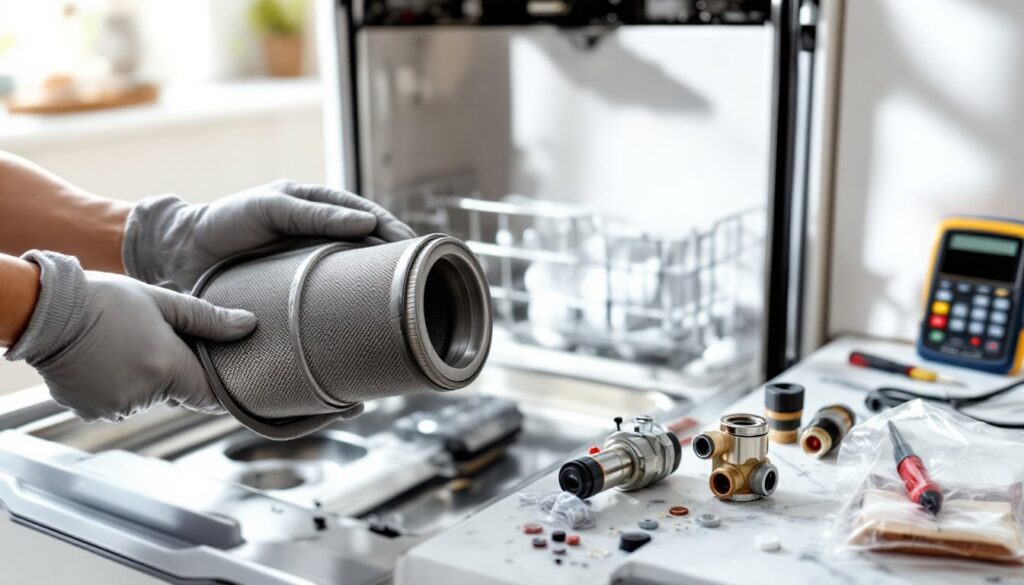
The filter assembly (also called the mesh filter or fine filter) traps food particles and prevents them from recirculating. Most newer dishwashers use a removable filter that should be rinsed weekly. If your dishes come out gritty or the machine smells bad, the filter is clogged. Filters can be cleaned, but damaged or cracked filters should be replaced.
Racks and tines break or rust, especially the lower rack near the silverware basket. Replacement tines are available as repair kits, or you can replace an entire rack if rust or broken welds are widespread. When shopping for parts for dishwasher upgrades, consider aftermarket racks if OEM replacements are expensive.
How to Identify Which Part Is Failing in Your Dishwasher
Diagnosing a dishwasher problem is a process of elimination. Start with the symptoms, then narrow down the likely culprits.
Symptom: Dishwasher won’t start
Check the door latch, door switch, and control panel first. Make sure the door clicks securely. If lights are on but the cycle won’t begin, the control board or door switch may be faulty. Test the door switch for continuity with a multimeter.
Symptom: Water won’t fill or fills slowly
Inspect the water inlet valve and supply line. Turn off power and water, then disconnect the inlet valve and check the screen for debris. If the screen is clean and the valve doesn’t click open when powered, replace it.
Symptom: Water won’t drain
Remove the filter and check for clogs. Listen for the drain pump during the drain cycle, if it hums but doesn’t pump, something is jamming the impeller (often broken glass or small objects). If the pump is silent, test it for power and continuity.
Symptom: Dishes aren’t clean
Clean or replace the spray arms, check water temperature (should reach at least 120°F for effective cleaning), and inspect the heating element. Low water pressure from a partially clogged inlet valve can also cause weak spray.
Symptom: Leaking water
Inspect the door gasket first. If the leak is from underneath, check the pump seals, hoses, and tub for cracks. A leaking inlet valve or loose hose clamp is also common. For dishwasher repair involving leaks, always dry the area and run a short cycle to pinpoint the exact source.
Symptom: Noisy operation
Worn wash motor bearings, a damaged pump impeller, or a failing drain pump can all cause grinding or buzzing sounds. Rattling often means a broken spray arm or loose rack.
Where to Source Quality Dishwasher Replacement Parts
Finding the right part starts with your dishwasher’s model number, usually printed on a label inside the door frame or along the top of the tub opening. Write it down before you start shopping.
OEM (Original Equipment Manufacturer) parts are made by the dishwasher brand (Bosch, Whirlpool, KitchenAid, GE, etc.). They fit precisely and match the original specs, but they’re typically more expensive. Order OEM parts directly from the manufacturer’s website or authorized service dealers.
Aftermarket parts are made by third-party manufacturers. They’re often 20–50% cheaper than OEM, but quality varies. Stick with reputable suppliers that offer warranties and good return policies. Aftermarket parts work well for common items like spray arms, gaskets, and filters, but for control boards and pumps, OEM is usually worth the extra cost.
Where to buy dishwasher replacement parts:
- Appliance parts retailers: Sites like AppliancePartsPros, RepairClinic, and PartSelect specialize in appliance parts. They offer search by model number, exploded diagrams, and installation videos.
- Big-box stores: Home Depot and Lowe’s stock some common parts in-store and can order model-specific components.
- Amazon and eBay: Good for fast shipping and competitive pricing, but verify seller ratings and return policies before ordering.
- Local appliance repair shops: Often stock popular parts and can order hard-to-find components. Prices may be slightly higher, but you get expert advice and no shipping wait.
Pro tip: When ordering online, compare part numbers, not just descriptions. A “drain pump for Whirlpool dishwasher” could fit dozens of models, only the exact part number guarantees compatibility. If you’re unsure, call the retailer’s support line with your model number before ordering.